

Yes. Most funny dog behaviors, like zoomies, head tilting, circling before lying down, and sniffing other dogs’ rear ends, are normal and come from instinct, communication, or play. A few, like frequent scooting, constant tail chasing, and a head tilt that never goes away, can point to pain, parasites, or stress. Watch how often the behavior happens, and call your vet or a trainer if it’s constant, new, or comes with other changes.
Table of Contents
- Introduction
- How to Tell Funny From Worrying (Quick Rule)
- The 10 Funny Dog Behaviors That Are Normal
- Zoomies
- Head Tilting
- Circling Before Lying Down
- Sniffing Other Dogs’ Rear Ends
- Butt Scooting
- Tail Chasing
- Eating Grass
- Rolling in Smelly Stuff
- Back Leg Kicking When You Scratch Their Side
- Staring at You While They Poop
- Normal vs. Not Normal: Quick Comparison Chart
- Why Dogs Do These Things: The Instinct Behind the Comedy
- Handler Notes: What Years Around Working Dogs Taught Me
- How to Respond to Quirky Behavior (Without Making It Worse)
- Frequently Asked Questions
- Final Thoughts
- Sources
Introduction
Ever watched your dog sprint laps around the living room for no reason, then stop and look at you like nothing happened? Or caught them spinning three times before dropping onto a perfectly flat bed?
You’re not alone. Every week, thousands of owners type “why does my dog do this?” into Google. Funny dog behaviors are among the most searched dog questions out there, because they make us laugh and worry in the same breath. Is it cute, or is something wrong?
Here’s the good news. Most of these quirks are normal. They’re leftovers from wild ancestors, built-in reflexes, or just a happy dog being a dog. But a few can signal a health or stress problem, and most articles on this topic don’t tell you which is which.
This guide does. You’ll learn:
- Why dogs do 10 of the funniest and most confusing things
- What the research says (with real numbers from real studies)
- The exact signs that mean “normal” versus “call the vet”
- Simple things you can do at home for each behavior
Let’s get into it.
How to Tell Funny From Worrying (Quick Rule)
Before the list, here’s the rule I give every owner I talk to. Ask three questions:
- Is it new? A dog who has always circled before lying down is fine. A dog who suddenly started is worth a closer look.
- Is it constant? Once in a while is a quirk. Many times a day, or being unable to stop, isn’t.
- Does it come with other changes? Limping, yelping, less appetite, hiding, aggression, or a change in poop or sleep all raise the stakes.
If you answer “yes” to any of those, book a vet visit. If everything’s a “no,” you’re almost certainly watching normal dog behavior.
The 10 Funny Dog Behaviors That Are Normal
1. Zoomies (Frenetic Random Activity Periods)
What you see: Your dog suddenly bolts around the house or yard, often with a low rear end, wide eyes, and a wild grin. Sometimes there’s a play bow first, then off they go.
Why it happens: Vets and trainers call these bursts “FRAPs,” short for Frenetic Random Activity Periods. They’re a way to release extra energy, excitement, or stress. They often show up after a bath, after a long time in a crate, or when you walk through the door. Puppies get them most, but dogs of any age can have them. Experts still don’t fully know why some dogs get zoomies often and others almost never do.
Is it normal? Yes. Zoomies aren’t harmful on their own.
What to do:
- Clear the path. Move tables, toddlers, and slippery rugs out of the way.
- Let them run in a safe, fenced space.
- Don’t chase them. Chasing can turn into a game that’s hard to stop.
- If your dog gets zoomies several times a day, add more walks, sniffing time, or puzzle feeders. Daily zoomies often mean “I’m bored.”
See a trainer or vet if: zoomies come with biting at your clothes or legs, or your dog can’t calm down afterward. Give them a quiet spot to wind down. For high-drive breeds, this exercise guide for working dogs shows how much physical and mental work they really need.
2. Head Tilting
What you see: You say “walk?” and your dog’s head cocks to one side like they’re thinking hard about it.
Why it happens: For years, people guessed dogs tilt their heads to hear better or to see around their snouts. A 2021 study in Animal Cognition by researchers at Eötvös Loránd University in Hungary offered a new idea. They tested 40 dogs. Seven were Border Collies called “gifted word learners,” because they could learn the names of many toys. Those seven tilted their heads about 43% of the time when they heard a toy’s name. The other 33 dogs did it about 2% of the time.
The takeaway: head tilting may show a dog is processing something meaningful, like a word they know. The study was small, and the authors say you shouldn’t assume a dog who doesn’t tilt is less smart. Dogs also tend to favor one side. A left tilter stays a left tilter.
Is it normal? Yes. It’s also a great way to get attention, because we love it and reward it with smiles and treats.
See a vet if: the tilt is constant (not just when you talk), or comes with loss of balance, eye flickering, stumbling, or head shaking. That can point to an ear infection or a vestibular problem. This is the one “cute” behavior where the red flag matters most.

3. Circling Before Lying Down
What you see: Your dog turns in two or three tight circles, paws at the bed, then flops down.
Why it happens: It’s an old instinct. Wild canines trampled grass, leaves, or snow to make a flat, comfy sleeping spot. Circling may also help them check for hidden bugs or snakes, and in cold weather it packs down a warm nest. It’s their version of fluffing your pillow.
Is it normal? Yes, completely.
What to do: Nothing. Make sure the bed has room to turn. Small beds can make big dogs struggle.
See a vet if: an older dog suddenly circles nonstop and can’t settle, which can be a sign of pain, arthritis, or confusion in senior dogs. A new, repetitive pattern in an older dog is worth a vet visit.
4. Sniffing Other Dogs’ Rear Ends
What you see: Your dog meets a new friend at the park, and within seconds, noses go straight to the back end. Yes, it’s awkward for you.
Why it happens: Dogs have scent glands near their rear ends that work like a name tag. One sniff can tell a dog a lot, such as who the dog is, and possibly their sex, age, mood, and health. Dogs “read” each other this way. It’s polite dog manners, not rudeness. Most dogs also sniff the face and body first.
Is it normal? Yes. A dog who can’t or won’t do this greeting at all may be nervous or under-socialized.
What to do:
- Keep the leash loose so your dog can move naturally.
- Allow a short greeting, then call them away before it gets tense.
- Don’t scold. Punishing a normal greeting can make dogs nervous around other dogs.
Step in if: you see stiff bodies, raised hackles, hard stares, or growling. That’s not a friendly sniff anymore.
5. Butt Scooting
What you see: Your dog drags their rear end along the carpet, lawn, or floor like a tiny sled.
Why it happens: Scooting is a way to relieve itchiness or pressure. The most common cause is full or irritated anal sacs (the glands near the rear). Other causes include worms, allergies, skin irritation, or a bit of stuck poop. Vets sometimes “express” the glands to see if they were full, and if so, the scooting usually stops.
Is it normal? Here’s the honest answer: scooting happens a lot, but it isn’t something to ignore. One quick scoot after a messy poop? No big deal. Repeated scooting? That’s your dog telling you something’s bothering them.
What to do: Check for redness, swelling, or a fishy smell. Watch for licking at the area. Book a vet visit if it happens more than once or twice, or comes with any of those signs. Keep up with deworming and flea control, and ask your vet about a year-round parasite plan.
6. Tail Chasing
What you see: Your dog spins in fast circles trying to grab a tail that’s “attacking” them.
Why it happens: For most puppies and young dogs, it’s play. Puppies are still learning that the tail belongs to them. Adul dogs may do it from boredom, extra energy, or to get a laugh out of you.
But tail chasing has a darker side. A 2012 study in PLoS ONE from the University of Helsinki looked at nearly 400 Finnish dogs, including Bull Terriers, Miniature Bull Terriers, Staffordshire Bull Terriers, and German Shepherds. It linked compulsive tail chasing with both genetics and environment. Dogs separated early from their mothers or whose mothers gave poor care were more likely to do it. The researchers also saw a hint that vitamins might help, but they said it wasn’t proven.
Is it normal? Occasionally, yes. Compulsive spinning isn’t.
What to do:
- Add exercise, sniffing walks, and brain games.
- Don’t laugh or fuss every time. Attention can reinforce it.
- Redirect to a toy or a simple command.
See a vet or behaviorist if: your dog spins daily, is hard to distract, hurts their tail, or seems anxious. Compulsive behavior often responds to a combined plan from a vet and a behaviorist.
7. Eating Grass
What you see: You walk past a lush lawn and your dog starts grazing like a tiny cow.
Why it happens: Many owners believe dogs eat grass to make themselves vomit. Research doesn’t back that up. A survey from the University of California, Davis, of about 1,500 owners found that 68% of plant-eating dogs ate plants daily or weekly. Only 8% looked sick beforehand, and only 22% vomited afterward. Earlier, in a first survey, 79% of owners said their dogs had eaten plants at some point. Other possible reasons include taste and texture, boredom, instinct, or a bit of extra fiber.
Is it normal? Yes. Most grass eating is a regular, harmless habit.
What to do:
- Keep your dog off lawns treated with pesticides or fertilizer.
- Skip compost heaps and unknown plants. Some are toxic.
- Offer chew toys or a short training game on walks to keep their mind busy.
See a vet if: your dog eats large amounts obsessively, vomits often afterward, loses weight, or suddenly starts when they never did before.
8. Rolling in Smelly Stuff
What you see: You’ve just given your dog a bath. Two minutes later, they’re flat on their back in something dead, mucky, or unspeakable.
Why it happens: Nobody knows for sure. The main theories are:
- Camouflage: Wild canines may have masked their own scent to sneak up on prey.
- Communication: Wolf researcher Pat Goodmann at Wolf Park found that wolves roll in strong scents and bring “news” back to the pack, who then sniff and investigate the rolling wolf. A study in the Canadian Journal of Zoology also found captive wolves were interested in unusual smells like perfume and motor oil.
- Pure enjoyment: Dogs don’t find foul smells disgusting the way we do. For them it’s a strong, interesting scent.
Is it normal? Yes, though some dogs never do it.
What to do:
- Spot the “stop, drop, and roll” setup: sniffing intensely, then lowering a shoulder. Call your dog away before the roll.
- Build a strong recall and a solid “leave it.” Our guide to essential protection dog commands covers both in simple steps.
- Wash quickly. Rolling in feces can expose dogs to parasites and bacteria.
I learned this the hard way with my first dog, Bruno, a German Shepherd mix. He once rolled in mud mixed with engine oil, and it took an emergency bath to fix. Since then I watch for the pre-roll sniff and call early.
9. Back Leg Kicking When You Scratch Their Side
What you see: You scratch your dog’s belly or side and one back leg starts kicking like a broken drumstick.
Why it happens: It’s the scratch reflex, a built-in nerve response. A touch on a certain spot triggers a leg kick, much like a knee-jerk in people. It helps dogs react to things like bugs or irritants on the skin. It happens without a thought, so your dog isn’t always “enjoying” it. Some dogs love it, but some find it mildly annoying.
Is it normal? Yes. It’s a healthy reflex.
What to do: Watch their face and body. Soft eyes and relaxed muscles mean they’re happy. Pulling away, lip licking, or stiffening means stop and try another spot, such as the chest or behind the ears.
See a vet if: your dog scratches the same area constantly or has red skin, hair loss, or visible fleas.
10. Staring at You While They Poop
What you see: Your dog finds the perfect spot, circles, and then locks eyes with you mid-business.
Why it happens: Pooping leaves a dog in a vulnerable position, so they may look to their trusted human for backup. It’s a sign of trust. Some dogs may also just be checking in or hoping for a treat afterward.
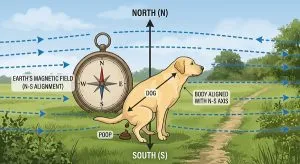
And here’s a bonus. A 2013 study in Frontiers in Zoology followed 70 dogs from 37 breeds over two years. Researchers recorded 1,893 poops and 5,582 pees. They found dogs tended to line up along the north-south axis when the Earth’s magnetic field was calm. Some scientists say the study doesn’t rule out other explanations, like the sun’s position, so treat it as interesting, not proven. Still, it makes a good story for your next dog walk.
Is it normal? Yes.
What to do: Give them space if they seem shy, and don’t rush them. Pay attention to the poop itself. Blood, mucus, or straining deserves a vet call.
Normal vs. Not Normal: Quick Comparison Chart
Most lists stop after “it’s normal.” Here’s the part they leave out.
| Behavior | Usually normal when | Call a vet or trainer if |
|---|---|---|
| Zoomies | Short bursts, happy body, safe area | Many times a day, or biting and can’t calm down |
| Head tilt | Happens when you talk or a noise plays | Tilt stays on, plus balance loss or eye flicking |
| Circling before lying down | A few turns, then settles | Nonstop pacing, can’t settle, new in a senior dog |
| Sniffing rear ends | Short, loose greeting | Stiff body, growling, or total fear of dogs |
| Scooting | One quick scoot | Repeated scooting, redness, odor, licking |
| Tail chasing | Short play session | Daily, hard to stop, injuries |
| Eating grass | Casual nibbling | Obsessive, repeated vomiting, weight loss |
| Rolling in smelly stuff | Occasional, easy to wash | Rolling in feces often, skin issues |
| Leg kicking | Brief, relaxed dog | Constant itching, skin damage |
| Staring while pooping | Looks at you, poops normally | Straining, blood, or mucus in stool |
Why Dogs Do These Things: The Instinct Behind the Comedy
Almost every item on that list comes from one of three places.
1. Wild ancestors. Circling, rolling, and grass eating trace back to wolves and other wild canines. Their habits helped them rest safely, hunt, or share information.
2. Built-in body reflexes. The scratch reflex and head tilts when processing sounds are automatic or nearly automatic. Your dog isn’t “choosing” them like a person would.
3. Emotion and energy. Zoomies, tail chasing, and play sneezes are ways dogs release excitement, boredom, or stress.
Do Breed and Age Change What’s Normal?
Yes, a bit.
- Puppies: Expect more zoomies, tail chasing, and chewing or tasting everything. Their bodies and brains are still learning.
- Herding breeds (Border Collies, Shepherds): More likely to circle, stare, and chase.
- Terriers and some bull breeds: Tail chasing deserves a closer look, since studies found it more often in Bull Terriers and German Shepherds.
- Senior dogs: Any new circling, pacing, or odd behavior is worth a vet check, because pain and cognitive changes can look like “quirks.”
How to Respond to Quirky Behavior (Without Making It Worse)
Here’s a simple plan you can use for almost any odd behavior:
- Observe first. Note what happened just before, how long it lasted, and how your dog looked.
- Rule out health. If it’s new, frequent, or painful-looking, call your vet.
- Meet the need. More exercise, more sniff time, better rest, a bigger bed, a cleaner routine.
- Teach an alternative. A solid recall, “leave it,” and “settle” fix most annoying quirks. Short, daily practice sessions build the focus these skills need.
- Stay calm. Dogs read your mood. Staying relaxed keeps funny behaviors from becoming stressful ones.
Final Thoughts
Funny dog behaviors are a big part of why we love dogs. Zoomies, head tilts, circling, grass munching, and smelly rolls all have real reasons behind them, and almost all of them are normal.
Here’s what to take with you:
- Most quirks are normal. They come from instinct, reflexes, and happy energy.
- Frequency and change matter most. A new, constant, or painful-looking behavior needs a vet.
- A few cute habits hide real problems. Repeated scooting, constant tail chasing, and a permanent head tilt need attention.
- Exercise, mental work, and calm training solve most issues. Don’t reward or scold, redirect.
- Know your dog’s normal. The better you know their baseline, the faster you’ll spot when something’s off.
So the next time your dog spins, zooms, or stares at you mid-poop, you can smile, and you’ll know exactly what’s going on.
Sources
- Dror, S. et al. (2021). Head tilting and word learning in dogs, Animal Cognition. Eötvös Loránd University (coverage via Big Think and ScienceAlert).
- Tiira, K. et al. (2012). Environmental Effects on Compulsive Tail Chasing in Dogs. PLoS ONE, University of Helsinki.
- Sueda, K. L. C., Hart, B. L., & Cliff, K. D. (2008). Characterisation of plant eating in dogs. Applied Animal Behaviour Science, UC Davis.
- Hart, V. et al. (2013). Dogs are sensitive to small variations of the Earth’s magnetic field. Frontiers in Zoology, 10:80.
- American Kennel Club: Why Dogs Roll in Smelly Stuff (akc.org).
- Dogster, “7 Weird Dog Habits: Vet-Verified Behavior Explained” (dogster.com).