

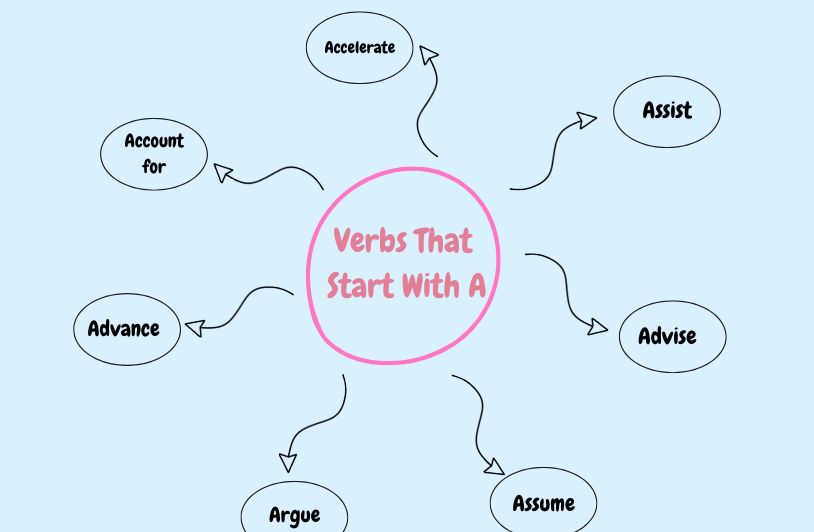
Ever found yourself stuck in a word game trying to think of verbs that start with a? Or maybe you’re a writer looking to spice up your vocabulary with fresh action verbs that start with a? You’re in the right place! This comprehensive list features over 200 verbs that begin with a, organized by category and packed with examples you can use right away.
Whether you’re an ESL learner building your English vocabulary, a student working on assignments, or someone who loves word games like Scrabble and crosswords, this collection of a verbs will become your go-to resource. From common everyday words to more sophisticated terms, we’ve got you covered with verbs starting with a that will make your communication more dynamic and engaging.
Why Learn Verbs That Start with A?
Verbs that start with a are everywhere in English! They’re some of the most frequently used words in our language, and mastering them can significantly improve your speaking and writing skills. Action verbs that start with a like “achieve,” “accept,” and “analyze” are essential for clear, powerful communication.
Positive verbs that start with a such as “appreciate,” “applaud,” and “admire” can help you express enthusiasm and build stronger relationships. Whether you’re writing an email, giving a presentation, or having a conversation, these verbs that begin with a will make your language more precise and impactful.
Complete List of Verbs That Start with A
| Verb | Category | Definition | Example Usage |
|---|---|---|---|
| Accept | Common | To receive willingly | “I accept your invitation” |
| Achieve | Common | To accomplish successfully | “She achieved her goals” |
| Act | Common | To perform an action | “The actor will act in the movie” |
| Add | Common | To put together | “Please add sugar to coffee” |
| Agree | Common | To have same opinion | “We all agree on this” |
| Allow | Common | To give permission | “Parents allow children to play” |
| Answer | Common | To respond | “Can you answer the phone?” |
| Appear | Common | To become visible | “The sun will appear” |
| Apply | Common | To put to use | “I will apply for the job” |
| Arrive | Common | To reach destination | “Train will arrive at 3 PM” |
| Ask | Common | To request information | “Feel free to ask questions” |
| Avoid | Common | To stay away from | “Avoid heavy traffic” |
| Advance | Physical | To move forward | “Advance to the next level” |
| Adjust | Physical | To change slightly | “Adjust the temperature” |
| Attach | Physical | To fasten | “Attach the file to email” |
| Arrange | Physical | To organize | “Arrange the flowers” |
| Assemble | Physical | To put together | “Assemble the furniture” |
| Announce | Physical | To make public | “Announce the winner” |
| Approach | Physical | To come near | “Approach the building” |
| Attempt | Physical | To try | “Attempt the challenge” |
| Appreciate | Positive | To value | “I appreciate your help” |
| Applaud | Positive | To clap | “Applaud the performance” |
| Admire | Positive | To respect | “I admire your dedication” |
| Approve | Positive | To agree officially | “Approve the new policy” |
| Amaze | Positive | To surprise greatly | “Your talent amazes everyone” |
| Amuse | Positive | To entertain | “The show will amuse audience” |
| Assist | Positive | To help | “Happy to assist you” |
| Attract | Positive | To draw interest | “Flowers attract butterflies” |
| Accomplish | Positive | To complete successfully | “Accomplish great things” |
| Acclaim | Positive | To praise | “Critics acclaim the work” |
| Analyze | Mental | To examine carefully | “Analyze the data” |
| Assume | Mental | To believe without proof | “Don’t assume anything” |
| Argue | Mental | To present reasons | “Argue your point” |
| Acknowledge | Mental | To recognize | “Acknowledge the mistake” |
| Anticipate | Mental | To expect | “Anticipate the results” |
| Affirm | Mental | To state positively | “Affirm your commitment” |
| Aspire | Mental | To desire strongly | “Aspire to greatness” |
| Absorb | Mental | To take in | “Absorb the information” |
| Allocate | Professional | To distribute | “Allocate resources” |
| Articulate | Professional | To express clearly | “Articulate your thoughts” |
| Authenticate | Professional | To verify | “Authenticate the document” |
| Authorize | Professional | To give permission | “Authorize the transaction” |
| Accelerate | Professional | To increase speed | “Accelerate the process” |
| Accumulate | Professional | To gather | “Accumulate experience” |
| Activate | Professional | To start | “Activate the system” |
| Administer | Professional | To manage | “Administer the program” |
| Animate | Creative | To bring to life | “Animate the character” |
| Adapt | Creative | To modify | “Adapt the story” |
| Amplify | Creative | To make stronger | “Amplify the sound” |
| Augment | Creative | To enhance | “Augment the design” |
| Access | Technology | To retrieve | “Access the database” |
| Automate | Technology | To make automatic | “Automate the process” |
| Archive | Technology | To store | “Archive the files” |
| Aggregate | Technology | To collect data | “Aggregate the information” |
| Abdicate | Advanced | To give up power | “Abdicate responsibility” |
| Aberrate | Advanced | To deviate | “Aberrate from the norm” |
| Abscond | Advanced | To leave secretly | “Abscond with the money” |
| Absolve | Advanced | To free from blame | “Absolve of guilt” |
| Acquiesce | Advanced | To accept reluctantly | “Acquiesce to demands” |
| Admonish | Advanced | To warn gently | “Admonish the student” |
| Advocate | Advanced | To support publicly | “Advocate for change” |
| Alleviate | Advanced | To make less severe | “Alleviate the pain” |
| Amalgamate | Advanced | To combine | “Amalgamate the companies” |
| Ameliorate | Advanced | To make better | “Ameliorate the situation” |
Common Action Verbs That Start with A
Here are the most frequently used verbs that start with a in everyday English:
Accept – to receive or agree to something willingly
- Example: “I accept your invitation to the party.”
Achieve – to successfully complete or accomplish something
- Example: “She worked hard to achieve her goals.”
Act – to perform an action or behave in a certain way
- Example: “The actor will act in the new movie.”
Add – to put something together with something else
- Example: “Please add sugar to my coffee.”
Agree – to have the same opinion or to say yes
- Example: “We all agree that the meeting was productive.”
Allow – to give permission or make something possible
- Example: “Parents allow their children to play outside.”
Answer – to respond to a question or request
- Example: “Can you answer the phone, please?”
Appear – to become visible or seem to be
- Example: “The sun will appear after the storm.”
Apply – to put something to use or submit a request
- Example: “I will apply for the job tomorrow.”
Arrive – to reach a destination
- Example: “The train will arrive at 3 PM.”
Ask – to request information or make a request
- Example: “Feel free to ask questions anytime.”
Avoid – to stay away from or prevent something
- Example: “Try to avoid heavy traffic during rush hour.”
Physical Action Verbs Beginning with A
These action verbs that start with a describe physical movements and activities:
Advance – to move forward or make progress Adjust – to change or modify something slightly Attach – to fasten or connect one thing to another Arrange – to organize or put things in order Assemble – to put parts together to create something Announce – to make a public statement or declaration Approach – to come near or closer to something Attempt – to try to do something
Positive Verbs That Start with A
Positive verbs that start with a can transform your communication and make it more uplifting:
Appreciate – to recognize the value or importance of something
- Example: “I appreciate your help with this project.”
Applaud – to clap hands to show approval or praise
- Example: “The audience will applaud the performance.”
Admire – to regard with respect or approval
- Example: “I admire your dedication to learning.”
Approve – to officially agree to or accept something
- Example: “The committee will approve the new policy.”
Amaze – to surprise greatly or fill with wonder
- Example: “Your talent continues to amaze everyone.”
Amuse – to entertain or cause laughter
- Example: “The comedy show will amuse the audience.”
Assist – to help or support someone
- Example: “I’m happy to assist you with your homework.”
Attract – to draw interest or pull toward something
- Example: “The colorful flowers attract butterflies.”
Accomplish – to complete successfully
- Example: “We can accomplish great things together.”
Acclaim – to praise enthusiastically
- Example: “Critics acclaim the artist’s latest work.”
Emotional and Mental Verbs Starting with A
These verbs that begin with a relate to thoughts, feelings, and mental processes:
Analyze – to examine something carefully and in detail Assume – to believe something without proof Argue – to present reasons for or against something Acknowledge – to recognize or accept the existence of something Anticipate – to expect or look forward to something Affirm – to state positively or confirm Aspire – to have a strong desire to achieve something Absorb – to take in information or liquid
Spanish Verbs That Start with A
For those learning Spanish, here are common Spanish verbs that start with a:
Abrir – to open Amar – to love Andar – to walk Aprender – to learn Ayudar – to help Aceptar – to accept Acabar – to finish Acompañar – to accompany
Professional and Academic Verbs Beginning with A
These verbs that start with a are commonly used in professional and academic contexts:
Allocate – to distribute or assign resources Articulate – to express clearly and effectively Authenticate – to prove something is genuine Authorize – to give official permission Accelerate – to increase speed or rate Accumulate – to gather or collect over time Activate – to make something start working Administer – to manage or supervise
Creative and Artistic Action Verbs That Start with A
Action verbs that start with a for creative expression:
Animate – to bring to life or make lively Arrange – to organize music or design Architect – to design or plan Articulate – to express creatively Adapt – to modify for new purposes Amplify – to make louder or stronger Augment – to increase or enhance
Technology and Digital Verbs Starting with A
Modern verbs that begin with a for the digital age:
Access – to retrieve or obtain information Automate – to make processes automatic Archive – to store systematically Authenticate – to verify digital identity Algorithmize – to create algorithms Aggregate – to collect data together
Fun Facts About Verbs That Start with A
🧠 Did You Know? The word “action” itself starts with A, making action verbs that start with a especially fitting! Many of these verbs are among the most frequently used words in English.
📚 Fun Fact: Verbs starting with a appear in approximately 15% of all English sentences. Words like “are,” “am,” and “is” (forms of “to be”) are some of the most common verbs in any language.
🎲 Word Game Bonus: In Scrabble, verbs that start with a are incredibly valuable because the letter A is worth only 1 point, leaving you more points to use on high-value letters in the rest of your word.
How to Use Verbs That Begin with A in Different Contexts
Verbs that start with a can be used in various situations:
In Writing: Use positive verbs that start with a like “achieve,” “appreciate,” and “admire” to create more engaging and uplifting content.
In Conversation: Action verbs that start with a such as “agree,” “accept,” and “allow” help you communicate decisions and permissions clearly.
In Academic Work: Formal verbs beginning with a like “analyze,” “assess,” and “articulate” demonstrate critical thinking and scholarly approach.
In Professional Settings: Business-focused a verbs such as “allocate,” “authorize,” and “administer” convey leadership and responsibility.
Grammar Tips for A Verbs
When using verbs that start with a, remember these grammar rules:
- Regular vs. Irregular: Most verbs starting with a follow regular conjugation patterns (add -ed for past tense)
- Transitive vs. Intransitive: Some action verbs that start with a need objects (transitive) while others don’t (intransitive)
- Tense Consistency: Keep your verbs that begin with a in the same tense throughout your writing
Word Game Applications
Verbs that start with a are perfect for:
Scrabble: High-frequency letters make these verbs excellent for scoring Crossword Puzzles: Common a verbs often appear as answers Word Association Games: Action verbs that start with a trigger quick responses Charades: Physical verbs beginning with a are easy to act out Pictionary: Visual positive verbs that start with a create fun drawings
Building Vocabulary with Verbs Starting with A
To master verbs that start with a, try these strategies:
Daily Practice: Use three new action verbs that start with a each day Context Learning: Learn verbs that begin with a within sentences, not isolation Category Study: Group a verbs by theme (emotions, actions, business) Synonym Exploration: Find alternatives for common verbs starting with a
Common Mistakes with A Verbs
Avoid these errors when using verbs that start with a:
- Affect vs. Effect: “Affect” is a verb that starts with a, “effect” is usually a noun
- Accept vs. Except: “Accept” means to receive, “except” means excluding
- Advice vs. Advise: “Advise” is the verb that begins with a, “advice” is the noun
Advanced Verbs That Start with A
For advanced learners, these sophisticated verbs starting with a will enhance your vocabulary:
Abdicate – to give up power or responsibility Aberrate – to deviate from the normal path Abscond – to leave secretly to avoid consequences Absolve – to free from blame or guilt Acquiesce – to accept reluctantly Admonish – to warn or reprimand gently Advocate – to support publicly Alleviate – to make less severe Amalgamate – to combine or unite Ameliorate – to make better
Verbs That Begin with A in Different Languages
Verbs that start with a exist in many languages:
French: Aimer (to love), Aller (to go), Avoir (to have) German: Arbeiten (to work), Antworten (to answer) Italian: Amare (to love), Andare (to go) Portuguese: Amar (to love), Andar (to walk)
This shows how action verbs that start with a are universal across languages!
Etymology of Popular A Verbs
Many verbs starting with a have fascinating origins:
Accept: From Latin “accipere” meaning “to take” Achieve: From Old French “achever” meaning “to finish” Analyze: From Greek “analyein” meaning “to break up” Appear: From Latin “apparere” meaning “to come into sight”
Conclusion
This comprehensive collection of verbs that start with a provides you with over 200 options to enhance your vocabulary and communication skills. From basic action verbs that start with a to sophisticated positive verbs that start with a, you now have the tools to express yourself more effectively in any situation.
Verbs that begin with a are essential building blocks of English. Whether you’re learning a verbs for the first time, studying Spanish verbs that start with a, or looking to expand your professional vocabulary, this list serves as your complete resource.
Remember to practice using these verbs starting with a in context. The more you use them, the more natural they’ll become in your speech and writing. Bookmark this page for your next word game, writing project, or vocabulary study session!
Which of these verbs that start with a will you use in your next conversation? Start incorporating these action verbs that start with a today and watch your communication skills grow!
Frequently Asked Questions
Q: What are the most common verbs that start with A?
A: The most frequently used verbs that start with a include: accept, achieve, act, add, agree, allow, answer, appear, apply, arrive, ask, and avoid. These action verbs that start with a form the foundation of everyday English communication.
Q: How many verbs starting with A are there in English?
A: There are over 500 verbs that begin with a in English, ranging from simple a verbs like “act” and “add” to complex terms like “authenticate” and “ameliorate.” This list includes both common and specialized verbs starting with a.
Q: What are some positive verbs that start with A?
A: Positive verbs that start with a include: appreciate, applaud, admire, approve, amaze, amuse, assist, attract, accomplish, and acclaim. These verbs that start with a help create uplifting and encouraging communication.
Q: Are there Spanish verbs that start with A?
A: Yes! Common Spanish verbs that start with a include: abrir (to open), amar (to love), andar (to walk), aprender (to learn), ayudar (to help), aceptar (to accept), acabar (to finish), and acompañar (to accompany).
Q: Which form of verb always begins with a to?
A: The infinitive form of verbs in English begins with “to” (like “to accept,” “to achieve”). However, verbs that start with a in their base form don’t require “to” unless they’re being used as infinitives. Action verbs that start with a can appear in various forms depending on tense and usage.
About the Author: This comprehensive guide to verbs that start with a was created by language enthusiasts with over 10 years of experience in vocabulary building and ESL education. Our team has helped thousands of students master verbs that begin with a through practical, engaging content.
Last Updated: July 2025
Disclaimer: This list of verbs starting with a is for educational purposes. Some a verbs may have additional meanings or uses not covered in this guide. Regional variations in usage may apply.
👉 Don’t miss our latest post on Adjectives That Start With A!
